What Causes Sciatica? Symptoms, Diagnosis, and Treatment Options
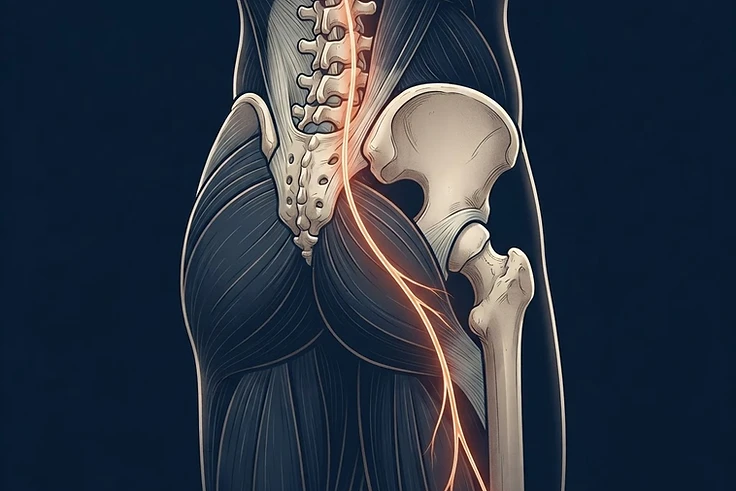
Sciatica is one of the most common causes of pain that travels from the lower back into the buttock and leg. For some people, it feels like a dull ache. For others, it can cause sharp, burning, or electric pain that makes sitting, walking, working, or exercising difficult.
Although sciatica is often described as a condition itself, the term generally refers to a pattern of symptoms caused by irritation or compression of nerves originating in the lower spine. Sciatica may occur alongside chronic low back pain, but the two are not necessarily the same. Identifying the underlying cause is important because treatment can vary considerably from one patient to another.
What Is Sciatica?
Sciatica refers to pain and other symptoms that travel along the distribution of the sciatic nerve. The sciatic nerve is formed by nerve roots originating in the lower spine and travels through the buttock and down the leg.
When one of these nerve roots becomes irritated, inflamed, or compressed, symptoms may travel from the lower back or buttock into the thigh, calf, or foot. This is also commonly referred to as lumbar radiculopathy.
Sciatica usually affects one side of the body, although the location and severity of symptoms depend on which nerve root is affected and the underlying cause.
What Does Sciatica Feel Like?
Sciatica does not feel the same for everyone. Symptoms may include:
- Sharp or shooting pain traveling down the leg
- Burning or electric-like pain
- Pain beginning in the lower back or buttock and extending into the thigh, calf, or foot
- Numbness or tingling in the leg or foot
- A pins-and-needles sensation
- Leg or foot weakness
- Pain that becomes worse with prolonged sitting
- Increased symptoms with coughing, sneezing, bending, or certain movements
Some patients have significant leg pain with relatively little back pain. Because the irritated nerve originates in the lumbar spine but travels into the leg, a spinal condition can sometimes produce symptoms primarily in the buttock, leg, or foot.
What Causes Sciatica?
Several conditions can irritate or compress the nerves in the lower spine.
Herniated Disc
A herniated disc is one of the most common causes of sciatica. The discs between the vertebrae act as cushions for the spine. When material within a disc pushes through or beyond its outer layer, it can irritate or compress a nearby nerve root.
Depending on the location of the herniation, pain, numbness, tingling, or weakness may travel into different areas of the leg.
Patients with persistent symptoms caused by certain disc herniations may eventually be candidates for minimally invasive treatments such as endoscopic laser discectomy after appropriate evaluation and nonsurgical treatment.
Lumbar Spinal Stenosis
Spinal stenosis occurs when the spaces available for the nerves become narrowed. This narrowing may result from age-related changes including arthritis, thickening of ligaments, enlargement of joints, disc degeneration, or a combination of these changes.
When narrowing affects a spinal nerve root, patients may develop sciatica or other symptoms in the leg.
Degenerative Disc Disease
Spinal discs naturally change with age. As a disc loses height and hydration, the relationship between the vertebrae, joints, and openings through which the nerves travel can change.
These degenerative changes may contribute to inflammation, narrowing around a nerve, or other conditions associated with back and leg pain. Degenerative changes can also contribute to other forms of chronic low back pain.
Spondylolisthesis
Spondylolisthesis occurs when one vertebra shifts relative to the vertebra below it. In some patients, this can narrow the space available for the spinal nerves and produce radiating leg pain.
Piriformis Syndrome
Piriformis syndrome can produce symptoms that resemble sciatica but does not originate from compression of a spinal nerve root. Instead, irritation of the sciatic nerve may occur near the piriformis muscle deep within the buttock. Patients may experience buttock pain that radiates down the leg, often worsened by prolonged sitting or certain hip movements. Because the symptoms can resemble lumbar radiculopathy, identifying the actual source of the pain is important.
Other Causes
Less commonly, sciatica-like symptoms can result from other conditions affecting the spine, pelvis, hip, or peripheral nerves. This is one reason an accurate diagnosis is important before beginning an interventional treatment.
How Is Sciatica Diagnosed?
Diagnosing sciatica begins with a detailed medical history and physical examination.
Your physician may ask where the pain begins, where it travels, what activities make it worse, and whether you have associated numbness, tingling, or weakness.
A neurological examination may evaluate muscle strength, sensation, reflexes, and walking. Certain physical examination maneuvers, including the straight-leg raise, may also reproduce symptoms associated with irritation of a lumbar nerve root.
Imaging is not always necessary immediately. When symptoms persist, are severe, or are accompanied by concerning neurological findings, additional testing may be appropriate.
MRI
Magnetic resonance imaging (MRI) provides detailed images of the discs, nerves, spinal canal, and surrounding soft tissues. It can help identify conditions such as disc herniation or spinal stenosis that may be contributing to sciatica.
X-rays
X-rays can provide information about spinal alignment, arthritis, degeneration, and other structural changes but do not visualize discs and nerves as clearly as MRI.
CT Scan
Computed tomography may be considered in certain circumstances, particularly when MRI cannot be performed or when additional information about the bony anatomy is needed.
EMG and Nerve-Conduction Testing
Electrodiagnostic testing may sometimes be used to evaluate nerve function or distinguish a lumbar nerve-root problem from certain peripheral nerve conditions.
Does Sciatica Go Away on Its Own?
Many episodes of sciatica improve with time and conservative treatment, particularly when symptoms are caused by a disc herniation.
Initial treatment may include remaining appropriately active, activity modification, medications when appropriate, and physical therapy. Prolonged bed rest is generally not recommended.
However, symptoms that persist, worsen, significantly interfere with normal activities, or are associated with neurological deficits may require further evaluation by a pain management specialist.
How Is Sciatica Treated?
Treatment depends on the cause and severity of the symptoms.
The goal is not simply to temporarily cover up pain. Treatment should address the suspected source of nerve irritation while helping the patient restore mobility and function. Interventional pain management may provide additional nonsurgical treatment options when conservative measures alone are insufficient.
Activity Modification
Temporarily avoiding activities that significantly aggravate symptoms may allow an irritated nerve to settle. This does not necessarily mean complete rest. Gentle activity and walking may be appropriate for many patients.
Physical Therapy
Physical therapy may focus on mobility, posture, core strength, flexibility, body mechanics, and exercises tailored to the suspected source of symptoms.
The appropriate exercise program varies from patient to patient. An exercise that helps one type of back or leg pain may aggravate another, which is why an individualized evaluation can be helpful.
Medications
Depending on a patient's symptoms and medical history, medications may be used as part of a comprehensive treatment plan. These may include anti-inflammatory medications and other medications used for certain types of nerve-related pain.
Medication is only one component of treatment and may not address the underlying mechanical source of nerve irritation.
Can Epidural Steroid Injections Help Sciatica?
For selected patients, an epidural steroid injection may be considered when sciatica persists despite conservative treatment.
During an epidural steroid injection, medication is placed into the epidural space near an irritated spinal nerve. Corticosteroid medication is used to decrease inflammation around the affected nerve root.
The injection does not physically remove a disc herniation or reverse spinal degeneration. Instead, the goal is to decrease inflammation and pain sufficiently to improve function and allow the patient to participate more effectively in rehabilitation.
The amount and duration of relief vary between patients. Some experience significant improvement, while others may experience limited or no benefit.
Patients interested in other minimally invasive treatment options can learn more about pain management services.
When Is Surgery Considered for Sciatica?
Most patients with sciatica do not automatically require surgery.
Surgical evaluation may become appropriate when symptoms remain severe despite nonsurgical treatment, when structural compression is producing significant neurological symptoms, or when progressive weakness develops.
For appropriately selected patients with a herniated disc, a discectomy can remove the portion of disc material compressing a spinal nerve.
Minimally invasive techniques, including endoscopic laser discectomy, may be options for selected patients depending on the location and characteristics of the disc herniation and the patient's symptoms.
The appropriate treatment should be based on the patient's examination, imaging findings, severity of symptoms, and response to previous treatment.
When Should I See a Pain Management Specialist for Sciatica?
Consider evaluation by a pain management specialist when:
- Leg or back pain persists despite conservative treatment
- Pain repeatedly returns
- Symptoms interfere with work, sleep, exercise, or daily activities
- You experience persistent numbness or tingling
- You would like to explore nonsurgical or minimally invasive treatment options
- The source of your pain remains unclear
An interventional pain management physician can evaluate the likely source of the symptoms, review imaging when appropriate, and determine whether treatments such as an epidural steroid injection or another targeted intervention may be appropriate.
To discuss persistent back, buttock, or leg pain, contact our office to schedule an evaluation.
Frequently Asked Questions About Sciatica
Most cases of sciatica are not medical emergencies. However, certain symptoms require immediate medical evaluation. Seek emergent medical attention for new loss of bowel or bladder control, numbness involving the groin or saddle region, intractable pain or severe or rapidly progressive leg weakness. These symptoms may indicate significant compression of the nerves in the lower spine and should not be treated as routine sciatica.
Sciatica occurs when a nerve root contributing to the sciatic nerve becomes irritated or compressed. Common causes include a herniated disc, lumbar spinal stenosis, degenerative changes in the spine, and spondylolisthesis. Sciatica-like symptoms may also occur from conditions outside the spine, such as piriformis syndrome.
Sciatica commonly causes sharp, burning, shooting, or electric-like pain traveling from the buttock into the leg. Some patients also experience numbness, tingling, or weakness. Symptoms can extend into the thigh, calf, foot, or toes depending on the affected nerve.
Yes. Some patients experience primarily buttock or leg pain with minimal or no lower back pain. Because the affected nerve originates in the lumbar spine and travels into the leg, nerve-root irritation can produce symptoms farther down the leg even when the back itself is not particularly painful.
Yes. In addition to pain, an irritated or compressed nerve can cause numbness, tingling, pins-and-needles sensations, or weakness in portions of the leg or foot.
The duration varies depending on the cause and severity. Many episodes improve over several weeks with conservative treatment, while some patients experience symptoms for months or develop recurrent episodes. Persistent or worsening symptoms should be evaluated to determine whether additional treatment is appropriate.
It can. Many cases, particularly those associated with a herniated disc, improve without surgery. Staying appropriately active, medications when indicated, physical therapy, and time may be sufficient. Persistent or severe symptoms may require further evaluation or interventional treatment.
Gentle walking is often better than prolonged bed rest for many patients with sciatica. However, activity should be guided by your medical provider and treatment team. If walking significantly worsens pain, numbness, or weakness, an evaluation may be appropriate before continuing an exercise program.
Prolonged sitting, bending, lifting, twisting, coughing, sneezing, or certain exercises may aggravate symptoms depending on the underlying cause. The movements that worsen sciatica vary from patient to patient.
Not every patient with new sciatica requires an immediate MRI. Imaging may become appropriate when symptoms persist despite conservative treatment, when an interventional procedure or surgery is being considered, or when significant or progressive neurological symptoms are present.
Yes. A herniated lumbar disc is one of the most common causes of sciatica. Disc material can irritate or compress a nearby spinal nerve root, producing pain, numbness, tingling, or weakness that travels into the leg.
For selected patients whose symptoms persist despite nonsurgical treatment, endoscopic laser discectomy may be considered depending on the characteristics of the disc herniation and other clinical findings.
Yes. Lumbar spinal stenosis can narrow the space available for spinal nerves. If a nerve root becomes compressed or irritated, pain and other symptoms may radiate into the buttock or leg.
Yes. Piriformis syndrome can cause buttock pain that radiates down the leg because the sciatic nerve passes near the piriformis muscle. Unlike lumbar radiculopathy, the suspected irritation occurs outside the spine. Because the symptoms can overlap with those of a herniated disc or other spinal conditions, evaluation can help determine the likely source.
Some patients notice improvement relatively quickly, while the corticosteroid component may take several days to produce its effect. Temporary soreness or fluctuation in symptoms can occur after an injection.
Yes. Sciatica can recur, particularly when the underlying spinal condition remains present. Maintaining strength, mobility, healthy body mechanics, and an appropriate exercise program may help reduce the likelihood of recurrent symptoms, although recurrence cannot always be prevented.
Surgery may be considered when significant symptoms persist despite appropriate nonsurgical treatment or when nerve compression produces concerning neurological deficits. The decision depends on the patient's symptoms, examination findings, imaging, and response to previous treatment.
When symptoms persist despite activity modification, medications, or physical therapy, additional evaluation may be appropriate. Depending on the underlying cause, treatment options may include an epidural steroid injection, other interventional pain management treatments, or surgical evaluation.
Patients with persistent symptoms can contact our office to schedule an evaluation and discuss appropriate treatment options.
Medical Disclaimer: This article is for general educational and informational purposes only and is not intended to provide medical advice, diagnosis, or treatment. Individual medical needs vary. Please consult a qualified healthcare professional for recommendations regarding your specific condition.
About the Author
Michael Ghermezi, M.D. is a physician specializing in pain management with advanced training in the diagnosis and treatment of acute and chronic pain conditions. He treats patients throughout Southern and Northern California with a focus on minimally invasive, evidence-based pain therapies.
Book an appointment